
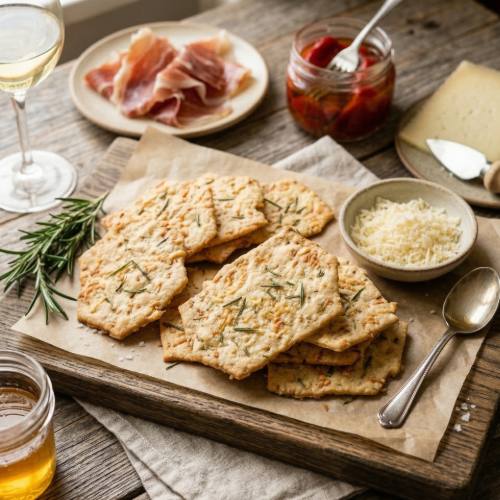
Rosemary Manchego Crackers
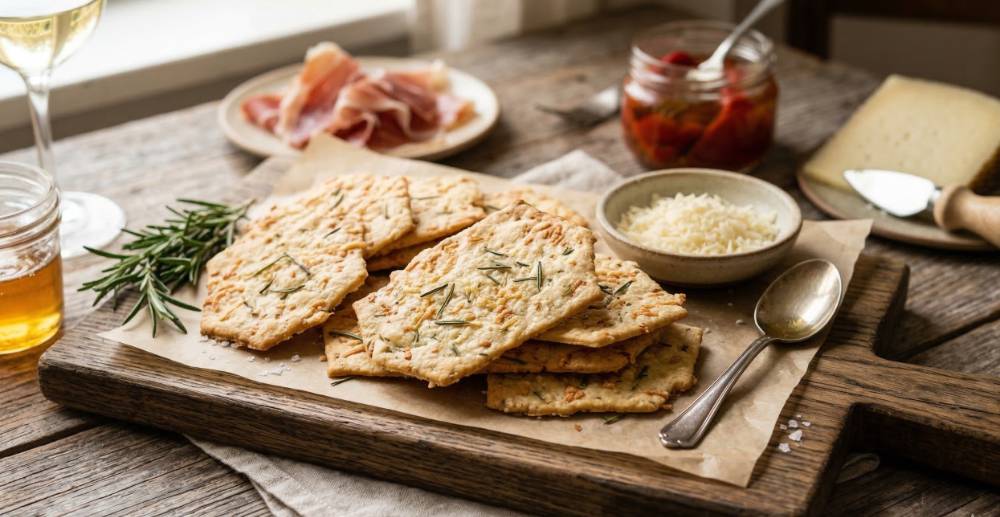 Homemade crackers are one of those things that seem fancy until you realize they take about 20 minutes of actual work. These rosemary Manchego crackers have the sharpness and complexity of aged cheese baked directly into the dough, which means they don’t need toppings—though they’re brilliant with jamón, piquillo peppers, or a simple spread of quince paste. Once you’ve made these, the thin, salty, mass-produced versions will never satisfy you again.
The Story Behind This Dish
Cheese crackers exist in almost every food culture, but in Spain they’re particularly refined. Rather than using mild cheddar, Spanish versions build on Manchego cheese, which brings a nuttiness and slight sweetness that standard crackers can’t match. The addition of rosemary is traditional in Castilla-La Mancha, where both the cheese and the herb grow abundantly. The combination is straightforward, but the technique matters enormously.
The beauty of these crackers is that they’re sophisticated enough to serve with a cheese course or wine, but simple enough to make any afternoon while listening to music in the kitchen. They’re the kind of thing that makes your home smell incredible and signals to any guest that you actually cook. Fresh rosemary makes all the difference; dried will work in a pinch, but the herb’s volatile oils are what make these special.
Ingredients
- 1 cup all-purpose flour
- ½ cup finely grated aged Manchego cheese (about 50g; use a microplane for best results)
- 4 tablespoons cold unsalted butter, cubed
- ½ teaspoon sea salt (fine grain)
- ¼ teaspoon freshly ground black pepper
- 2 teaspoons fresh rosemary, finely chopped (not the woody stem)
- ¼ teaspoon smoked paprika (optional but recommended)
- 3–4 tablespoons ice water (add slowly)
- Optional: fleur de sel or finishing sea salt for the top
How to Make It
- Combine dry ingredients. In a medium bowl, whisk together the flour, grated Manchego, salt, black pepper, fresh rosemary, and paprika if using. The cheese should be finely grated so it distributes evenly throughout the dough. This is important for flavor consistency.
- Cut in the butter. Add the cold butter cubes to the flour mixture. Using your fingertips or a pastry cutter, work the butter into the flour until the mixture resembles coarse breadcrumbs. The butter should be in pea-sized pieces; this is what creates flakiness in the final crackers. Keep everything cool—warm butter makes tough crackers.
- Add water gradually. Sprinkle the ice water over the mixture, a tablespoon at a time, mixing gently with a fork until the dough just comes together. You want it barely hydrated—it should be shaggy and barely hold together when pressed. Too much water makes dense crackers. Start with 3 tablespoons and add only what you need.
- Chill the dough. Form the dough into a rough ball, wrap it in plastic, and refrigerate for at least 30 minutes. This lets the gluten relax and makes the dough easier to roll. You can chill it for up to 2 hours.
- Preheat and prepare. Heat your oven to 375°F. Line a baking sheet with parchment paper. If your dough is very cold, let it sit at room temperature for 5 minutes before rolling—it will be easier to work with.
- Roll the dough thin. On a lightly floured surface, roll the dough to about ⅛ inch thick. This should be thin enough to see light through it in places. Use a ruler if you’re obsessive (I am). The thickness is crucial—too thick and they’re chewy; too thin and they burn before they crisp.
- Cut the crackers. Using a sharp knife, pizza cutter, or pastry wheel, cut the rolled dough into squares or rectangles about 2 inches on each side. Don’t worry about perfect shapes; rustic is fine. A little irregularity adds charm. Prick each cracker a few times with a fork to prevent puffing.
- Arrange and season. Transfer the crackers to the prepared baking sheet, spacing them about ½ inch apart. They don’t need to not touch, but they shouldn’t be crowded. If you want, brush very lightly with water and finish with a tiny pinch of fleur de sel on top.
- Bake. Bake for 10–14 minutes, until the edges are golden and the crackers are crispy throughout. Start checking at 10 minutes; oven temperatures vary. They should be light golden, not dark brown. The bottom should feel hard and crisp when you press it.
- Cool completely. Transfer to a wire rack. The crackers will crisp further as they cool. Don’t eat them warm; wait 10 minutes. They’ll shatter and crunch much more satisfyingly once fully cooled.
Tips for the Best Result
- Use aged Manchego, not young cheese. Young Manchego is creamy and mild; aged Manchego (6+ months) has crystalline texture and deeper, nuttier flavor. The complexity is essential here. Grate it finely so it integrates fully into the dough.
- Keep everything cold during dough-making. Use cold butter, ice water, and chill the dough. Warm dough spreads and becomes greasy. Cold dough is manageable and produces flaky, crisp crackers.
- Don’t overwork the dough. Mix until the dough just comes together. Overworking develops gluten, which makes them tough instead of tender and flaky. This isn’t bread; it’s more like pie dough.
- Roll thin and prick well. Thin crackers are crispy; thick ones are chewy. The fork pricks prevent them from puffing in the oven, which can make them uneven. Be consistent with your pricking.
- Store properly. Crackers stay crisp in an airtight container at room temperature for up to 5 days. They’ll soften over time, but you can re-crisp them in a 325°F oven for 3–4 minutes.
Wine Pairing
These crackers are nearly a perfect vehicle for Spanish wine. Serve them with a crisp Albariño or Verdicchio, whose mineral notes echo the Manchego. They’re also excellent alongside a dry Fino Sherry or a young, slightly spicy Garnacha Blanca. The crackers’ nuttiness and salt work with almost any dry white wine from Spain.
Frequently Asked Questions
Can I use store-bought Manchego?
Yes, any quality Manchego works. Aged Manchego is better than young, but store-bought aged versions are still excellent. Just avoid pre-grated cheese—it contains anti-caking agents that interfere with the dough texture. Grate it yourself.
What if my crackers are too thick?
Thickness is the most common issue. Next time, roll the dough a bit thinner. Aim for a thickness where you can almost see light through it. If your crackers turned out thick this time, break them up and use them as croutons in a salad or soup—they’re still delicious.
Can I add other herbs?
Fresh rosemary is traditional, but you could substitute thyme, oregano, or even a touch of smoked paprika for a Spanish twist. Keep the herb amount the same—about 2 teaspoons fresh or ½ teaspoon dried. Don’t add too many different herbs; let the cheese shine.
Ingredients
- 1 small parsnip (about 4 ounces), peeled
- 2 cups all-purpose flour
- 1 teaspoon salt
- 1 teaspoon granulated sugar
- 1/4 teaspoon freshly ground pepper
- 1 1/2 sticks (12 tablespoons) cold unsalted butter, cut into small pieces
- 1/2 cup finely grated manchego cheese (about 1 1/2 ounces)
- 2 1/2 teaspoons finely chopped fresh rosemary
- 1 large egg yolk
- 1/4 cup ice water
- Sea salt for sprinkling on the crackers
How to prepare
- Finely grate parsnip (you will need 1/2 cup).
- Place on a clean kitchen towel (do not use paper towels), and squeeze to extract as much liquid as possible.
- Pulse parsnip, flour, salt, sugar, pepper, butter, cheese, and rosemary in a food processor.
- Add yolk, and pulse to combine.
- With machine running, add ice water in a slow, steady stream, processing until dough just comes together (no longer than 15 seconds).
- Divide dough into four and shape into a disks, and wrap in plastic.
- Refrigerate for at least 30 minutes (or up to 2 days). Or freeze for up to 3 months.
- On a lightly floured surface, roll out dough to a thin 1/8 inch thick.
- Working with one disk at a time, cut out 3-inch rounds, gathering scraps and rerolling dough if needed. Place on parchment-lined baking sheets.
- Refrigerate until chilled, about 30 minutes. Meanwhile, preheat oven to 350 degrees.
- Pierce the cracker rounds with a fork several times before placing inside the hot oven to avoid the dough from rising.
- Lightly sprinkle sea salt on top.
- Bake for 6 minutes. Remove from oven and carefully flip them over.
- Place them back in the oven and bake for an additional 5 to 6 minutes until golden brown.


Comments